
SOIL CARBON FACTS
Aggregation
Large emitters or buyers of carbon credits do not want to deal in small quantities. To overcome this limitation, Aggregators put together numerous carbon projects and “aggregate” the credits into larger lots for sale. Aggregators may operate in different ways, e.g…
- They may buy all the credits and on-sell them
- They may take one large project to the Government and make that up with lots of individual contracts.
- They may charge for all services.
- They may take carbon credits in lieu of payment for services. This is the most common approach in agriculture.
Discovery
At this point in the development of the carbon trading market there are many risks and uncertainties. For example, what are the opportunities? How much will it cost? What will I make out of it? Is it worth doing? This is the situation most of all new clients are in and so that is why we are in the business of Advisory.
“Discovery” is intended to be a relatively short feasibility study with a small fixed budget to collect available information and make preliminary estimates of the potential costs, benefits and issues that may be encountered should a carbon trading project be undertaken.
The suggested budget for the Discovery Project is only a few thousand dollars per property. The higher the budget the more detail and certainty can be achieved. The information collected in the Discovery feeds directly into subsequent stages of work, reducing ongoing costs.
At the end of Discovery you should be in a position to make informed decisions on how to progress and have a good idea of the cost, risks and potential returns. This includes:
- The likely range of potential carbon stock improvements over time.
- The areas of the property that are suited to sequestration projects.
- The magnitude and need to include other carbon stocks and flows like livestock, fertiliser, biomass, feed and supplements and fire that will affect the overall carbon project under CFI.
- What information you have and what additional information and systems will you need to put in place in order to operate an offset project under CFI?
- The costs of future work and potential benefits including sensitivity analysis.
- You will have all the information ready to enable the site soil carbon testing work to commence, when a decision is made to proceed.
Perhaps most importantly if the outlook doesn’t look good then you get to stop or postpone the project before you have had to commit any significant funds.
Baselining
Measuring soil carbon stock is fundamental to any soil carbon trading project. NACS has recognised in supporting soil carbon projects that there are few in the market offering high quality cost effective soil carbon measurement services. What is available can be described as a “cottage industry”, often linked to research and government organisations, and aggregators looking to make significant profit.
To fill this gap NACS implements a carbon measurement system that can meet the demands of the soil carbon trading market with the following:-
- Deeper sampling: – Most other measurement system limit sampling to 300mm. However, there is often more soil carbon below 300mm than above and this carbon can be expected to be very stable. Furthermore, well managed land is expected to promote deeper soil carbon.
- Detailed soils mapping: – Many current sampling methods can only estimate the total amount of soil carbon and don’t provide any information about how soil carbon varies across paddocks and the property as a whole. Without this information it is hard to identify the
sweet spots or relationships between, management practice and soil carbon levels. - Detailed information. NACS employs a range of new technologies to measure and interpret soil carbon tests. These are not only faster but provide greater insight into the soil carbon and how it varies across the target area.
- Stratification. Soil variation is the enemy of accurate measurement of soil carbon. Accurately assessing soil variation to a depth of 1 to 2m, greatly improves the accuracy of the soil carbon measurement. The more accurate the measurement, the more carbon is saleable due to lower variation in the estimated carbon yield.
- Baselining is the first critical step in any soil carbon project. Baselining involves measuring soil carbon stocks on the target land area. The initial carbon stocks are used to calculate any future soil carbon sequestration so the sooner you baseline the more soil carbon you potentially have to trade.
Baselining involves 5 steps:
Accurately map the area to be measured and select the Carbon Estimation Areas (CEA). A CEA is an area of land that will be used as part of a sequestration project. A property may have several CEA’s and not all of a property needs to be covered.
Stratify the area. This means breaking the CEA’s into a number smaller areas to direct the physical sampling and support the statistical estimation of carbon stocks.
Physical sampling involves taking samples of soil at locations determined by the sampling plan.
Sample analysis involves physical and chemical analysis of soil samples to determine the carbon content.
Carbon stock estimation involves statistical and other analysis to estimate the carbon stocks in the CEA and how it varies across the target area.
Carbon Project Management
Setting up a carbon project is a complex task. Not only do you have to comply with a 250 page methodology, which is enshrined in law, but there are many steps to both completing and maintaining a project which can be verified by an auditor. Without verification, credits will not be issued. This typically raises the level of paperwork required and NACS will provide the systems to take most of the pain out of the process.
Apart from the actual requirements, the whole project information must be kept intact for up to 50 years, which may be beyond the current ownership of the land, even though the project may continue. With our partners, NACS is developing strategies for managing carbon loss risk over the life of the project.
What is soil carbon?
Soil is a hugely complex matrix of living organisms, inert minerals and organic matter. There are more organisms in a teaspoon of healthy soil than there are humans on the planet. In this mix, carbon, in various forms, plays a vital role in soil health and productivity. Soil carbon is in constant flux, cycling between more and less stable forms in processes that fuel much of the web of life in the soil. A common and informative, but simplistic, description of soil carbon is to classify it into three pools relating to how carbon is cycled and stored in soil:
1. The labile pool which includes living and readily decay-able plant matter and other organic substances.
2. Humus pool which is assumed to include a range of relatively stable forms of carbon that contribute most to soils structure and health.
3. Recalcitrant carbon which includes very stable substance such as charcoal. The listed carbon pools are a very useful way of describing and understanding soil carbon and have been successfully applied in models to predict and understand carbon dynamics in soil. As useful as the soil carbon pool description is, there is a growing recognition that soil carbon is much more complex and dynamic as the simplified pool model suggests. The emerging view is that soil carbon is a function of the overall soil matrix ecosystem. In particular the limitations of the concept of humus as a class of stable chemical compounds is being replaced by a greater understanding of the importance of roots and stable aggregates within the soil matrix.
In the context of carbon trading, soil carbon is a quantity that can be measured by a set of agreed methods. Typically this is done by sieving out particles >2mm and then measuring the remaining carbon by chemical or combustion based methods. You don’t need to understand the complexity of soil carbon in order to trade soil carbon. A deeper understanding of soil carbon is however very useful to understanding how it can be improved over time.
How can soil carbon be increased?
Soil carbon levels are ultimately the result of a balance between processes and inputs that add carbon to soil and those that remove it. To increase soil carbon you need to reduce processes that lead to loss of soil carbon loss and increase processes that lead to carbon gain. This sounds simple and in some respects it is. If you want to increase soil carbon stop doing things that decrease soil carbon and start doing things that increase soil carbon. But what are the good and bad things?
The conventional view is that soil carbon is all derived from the surface and matches the surface yield. This top down thinking says that vegetation and litter at the surface is progressively incorporated into the soil matrix where it is gradually transformed by biological processes into more stable forms such as humus. Along the way most of the carbon is consumed by bacteria and readmitted as CO2. The top down view of soil carbon completely misses the importance root exudates in the formation and stabilisation of soil carbon. In grasslands, a large portion of the living biomass is in the roots. The above ground parts of the plants produce carbohydrates by photosynthesis. Some of this is used to grow the plants and roots but a significant portion of the production is directed below ground and is exuded by the roots to feed both bacteria and fungi that in turn provide minerals and nutrients back to the roots and plants. By feeding the soil biology a plant greatly expands the resources it can access by its roots alone.
Roots and root exudates play a vital role in soil carbon formation. Grasses continuously lose or slough off roots as part of normal growth and in response to grazing. This is particularly the case for finer root hairs. Understandably, roots are well adapted to being in the soil and are resistant to biological decay so tend to remain in the soil long after being separated from the plant. Exudates also play an important role in helping to promote stable aggregates in the soil structure. These aggregates can range from the microscopic scale to many mm. In the right conditions these aggregates will bind to and protect root and other organic matter isolating them from further biological decay. The aggregates also contribute to overall soil structure and water infiltration and retention.
It is also important to understand what destroys soil carbon. Soil carbon can be lost when there is a lack of carbon input, soil temperature increases, soil is ploughed and or compacted or when substances are added that disrupt soil biology including causing an increase in biological activity that results in a breakdown of previously stable soil carbon. Over grazing, bare ground, ploughing, bare fallowing, some forms and methods of fertiliser, pesticides and herbicide use, excess concentrations of nitrogen from manure and urine can all contribute to a loss of soil carbon.
It is not at all surprising that grasses and grazers have co-evolved over millions of years. Many grasses have evolved to respond to grazing. Many grasses need to be grazed in order to be more productive. Research has shown that there is a sweet spot between no grazing and overgrazing that maximizes net primary production. It is not just the amount but the timing and intensity of grazing that matters. When a plant is grazed it rapidly adjusts its physiology in response. Resources are diverted to regrowing new tillers and roots, growth stops and the plant can even shed roots to balance the overall needs of the plant. It is only after the plant has regenerated that resources are put back into the roots. The plants response also depends on the season and the availability of water and the intensity of grazing. If excess plant material is removed the plant will struggle to recover. If the plant is repeatedly cropped before it recovers, it never gets to the stage that the roots start to regrow and without strong roots the plant cannot access enough water and nutrients to reach its potential.
Timing is also important. When a plant is dormant grazing has less of a direct impact because the plant is not actively growing. The extent of grazing will however affect the plant’s capacity to respond to rain and the growing season. Conversely if a plant is repeatedly cropped during the growing season, it never has the opportunity to develop strong roots. Finally it is also important to consider what happens in the absence of grazing. Here the above ground leaves ages and die or become less efficient. The dead matter restricts sunlight from reaching new growth. The plant stops growing and becomes unpalatable and difficult to digest. When pasture plants are heavily grazed, the tussock gets smaller—
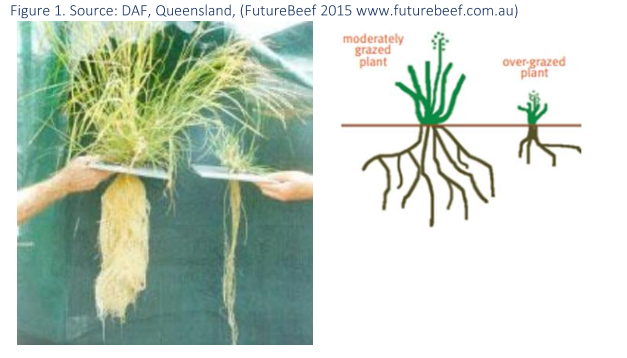
fewer tillers are produced, the root system contracts, less seed is set—and the plant may die out. These effects are most severe on the pasture species that stock prefer, and least severe on the unpalatable species (Spies et. al 2006). The impact of different grazing approaches is clearly demonstrated in the following pictures. An over-grazed plant compared to a moderately grazed plant. Note the difference in root mass.
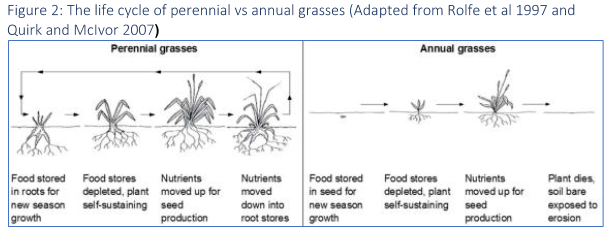
Perennial grasses are better at protecting the soil from erosion because they tend to survive through the dry season. In contrast, annual grasses tend not to survive into the dry season and leave bare soil exposed to erosion (see Figure 2).
 In addition, perennial grasses have deeper root systems that help water to infiltrate into the soil. “Perennial, Palatable and Productive” (3P) grasses are favoured as they are more productive and palatable for cattle. With this knowledge comes a simple formula for improving soil carbon in a grazing system. Good grazing results in good grass, which results in good roots, which builds soil carbon.
What is the potential?
Key points
1. Improved grazing practices have the potential to sequester carbon and can have significant benefits at local, national and international level.
2. The mechanisms of soil carbon sequestration under improved grazing are well established.
3. Associated N2O emissions and loss of soil carbon due to priming do occur but there is still significant net sequestration.
Soil Carbon and Grazing Lands (including both rangelands and pasture, scrubland and cropland sown with pasture) estimates of globally terrestrial carbon stocks (carbon stored in soils) is typically reported to be in the order of 1500–1600 Pg C which is 3 times the size of carbon stored in vegetation (~560 Pg C) (Johnston & Groffman, 2004) and 2 times the size of the carbon in the atmosphere (~770 Pg C). These estimates are for the first 300 or 1000 mm of soil depth which are generally assumed to contain the bulk of the carbon. Estimates of deeper soil carbon add an additional 33% in the 1-2 m zone and a further 23% to 2-3m zone taking the total estimated storage in soil to 3 m to 2344 Pg C (Jobbágy & Jackson, 2000) which is more than 3 time the carbon in the atmosphere.
Grazing lands occupy around 3.5 billion hectares which is 26% of global land area and 70% of global agricultural land (Follett & Reed, 2010) (Conant, 2010). It is estimated that soil in grazing lands sequester around 0.7 Pg CO2y-1 (191 Tg Cy-1) or about 20-25% of the total carbon sequestered in all soils (Lal, 2011, Follett & Reed, 2010; Conant, 2010). Historic land use and soil degradation, particularly conversion of native vegetation to agriculture, has resulted in the loss of 25 to 75% of original soil carbon in many areas of Australia, estimated to be equivalent to around 286 Tg CO2 ( reported as 78 Gt of C).
Within Australia grazing lands occupy approximately 444 million hectares or 57% of the total land area and more than 90% of the agricultural land (Sanderman, Farquharson, & Baldock, 2010). Dean (Dean, Wardell-Johnson, & Harper, 2012) using the land use definition of “rangeland” estimate 661Mha of rangeland of which 369 Mha is occupied by commercial livestock properties.
Restorative agricultural practices across all agricultural land (cropping, grazing and rangelands) is estimated to have the potential to sequester 1.8-4.5 Tg Cy-1( reported as 1.2–3.1 billion tons Cy-1) (Lal, 2011). Estimates of the scale of the net benefit of improved management of agricultural land range from 5 to 14% of total emission (Chan et al., 2008).
Estimates of potential sequestration in grazing land vary depending on assumptions:
27 Tg Cy-1in grazing lands (Cosier, Flannery, Harding, & Karoly, 2009).
The Garnaut Review (Garnaut, 2011) quotes CSIRO estimates that rehabilitating 200 million hectares of overgrazed rangelands could have a technical potential to sequester 100 Tg CO2ey-1 (27 Tg Cy-1) between 2010 and 2050.
The Garnaut Report estimates 77 Tg C y-1 (286 MtCO2y-1) over 358 million hectares of degraded land for 20 to 50 years at 0.23 C ha-1 y-1 although some of the assumption in this estimates are challenged by other analysis (Gifford).
Globally rehabilitation of overgrazed grasslands can sequester approximately 45 Tg C y-1, most of which can be achieved simply by cessation of overgrazing and implementation of moderate grazing intensity. Within this estimate 4.5 Tg Cy-1 is in the Asia pacific region (Conant & Paustian, 2002).
There remains considerable uncertainty in soil carbon stock estimates and sequestration potential and there are limitations in the extrapolations inherent in meta-analysis studies of global sequestration potential. However, while the change in soil carbon per unit area may be small and uncertain the total area is so large such that even conservative estimates show the potential of soil carbon sequestration as a significant contribution to national and global carbon budgets and efforts to address climate change.
Sequestration Rate
There is a paucity of long terms paired studies of potential soil carbon improvements under grazing systems and very limited data on well managed Cell Grazing Systems. This is compounded by the heterogeneous nature of grazing land and grazing managementpractices. However, a significant number of studies do provide strong evidence that properly managed grazing can positively affect soil carbon stocks.
- Conant (2002) estimates rates of sequestration across Australia to be between -5 to 1 Mg C ha-1 y-1 with rates of increase of 0.5 to 1 Mg C ha-1 y-1 in favourable sites covering much of the northern parts of Australia.
- Unpublished paired samples of cell and continuous grazing properties indicate an average annual sequestration of 0.7 Mg C ha-1 y-1 in the top 15cm (RCS).
- The Chicago Climate Exchange use 0.3 to 1 Mg C ha-1 y-1 as well as providing correlation to sequestration rates with annual precipitation and differentiated risk and insurance factors in various regions.
- Studies of improved pasture and changes to grazing management for a number of studies as reported by Sanderman et al (2010) suggest a sequestration rate in the range of 0.1 to 3 Mg C ha-1 y-1 though generally * Lal (2011) reports sequestration rates of between 0.05 to 1.5 Mg Cha-1 y-1r for various types of recommended agricultural management practices.
- NSW DPI summarise available data to give a range of sequestration rates of -0.25 to 1.3 Mg C ha-1 y-1 (Chan, Cowie, Kelly, Singh, & Slavich, 2008).
- Estimates of conversion of crop land to grassland 1.44 Mg C ha-1 y-1 in Europe and 0.64 Mg C ha-1 y-1 (144 g C/m2/y) in the USA (Abberton, Conant, & Caterina (2010).
- In a study to support the development of sequestration factors for IPCC Good Practice Guide which reviewed available data in a number of areas around the world Ogle (Ogle, Conant, & Paustian 2004) derived sequestration rates for conservative grazing to be in the range 0.1 to 0.9 Mg C ha-1 y-1 covering low, medium and high levels of intervention.
- Conant identifies improved grazing management as a major opportunity to sequester carbon and estimates an average sequestration rate across all potential improved grazing practices of 0.35 Mg C ha-1 y-1 (Conant, 2010).
Base on the studies listed above a conservative estimate of the expected rates of sequestration applicable to Australia appears to be around 0.5 to 1 Mg C ha-1 y-1. However, the listed studies provide no guarantee and it is recognised that sequestration may be higher or lower and will depend on local soil type, climate and management practices.
Duration and saturation
The time period for which sequestration can be expected to continue, the total change in carbon stocks and the final saturation or stabilisation carbon level are all dependant on climate, soil and management practice (West & Six, 2006). Total changes in soil carbon range from a few percent of initial carbon in cold temperate moist environments to over 100% in tropical locations with expected sequestration durations of between 25 and 45 years (West & Six, 2006). Significantly longer sequestration periods have been observed in other landscapes and management systems (Batjes, 1999).
The concept of saturation of carbon in soil – a maximum level of soil carbon achievable – is discussed by several authors (Stewart, Paustian, Conant, Plante, & Six 2007; West & Six 2006; Sanderman et al. 2010). That there is a limit to the amount of carbon that soil can contain appears logical but specifying such a limit is more problematic. It is not clear whether equilibrium, steady state or saturation are appropriate to describe soil carbon levels over time (West & Six, 2006). The quantity of carbon in soil is based on the dynamics between inputs and losses. Changes in soil, climate, management or other environmental factors can affect soil carbon levels. These impacts can occur at multiple time scales and in a three dimensional environment which may also gain or lose mass and volume over time. While a particular soil stratum may achieve equilibrium there could be ongoing changes in other stratum. Accordingly it is difficult to quantify a saturation level across a larger parcel of land. However, within in the context of a carbon accounting framework it is likely that a point will be reached where the rate of sequestration will decline to the point that it is no longer cost effective to continue further sampling in order to quantify ongoing changes. The expected time period for this to occur is 25 to 40 years.
How grazing effects soil carbon stocks.
The term grazing covers a wide variety of practices from nomadic herds moving through native vegetation and rangelands to intensively managed pastures and livestock. Grazing is one of the most widely practiced agricultural activities occurring in over half of the global lands and over one third of the above and below ground carbon stores (from Han et al., 2008
citing Allen Dais 1996).
A large portion of the literature discussing the impacts of grazing provides relatively simplistic classifications of grazing intensity (e.g. heavy, medium, light) and does not quantify important factors such as the stage of growth of various pasture species, precent of biomass removed, the intensity or number of grazers per unit area and the length of rest between grazing events if any, all of which can affect pasture growth and productivity. There is however ample evidence that excessive grazing pressure results in a decrease in productivity. Less commonly recognised is that there is a level of grazing that is both sustainable and may in fact have higher Net Primary Production then ungrazed pasture
(McNaughton, 1979).
There is a considerable body of research on the impacts of grazing on soil carbon. These include overviews of potential carbon sequestration in agricultural systems (for example Follett & Reed, 2010; Lal, 2011; Sanderman et al., 2010; Slavich, 2008), and numerous studies of specific mechanisms (Conant & Paustian, 2002). Pasture species have several characteristics that support, and even require, grazing. Perhaps not surprisingly, there is evidence of stepwise reciprocal adaptations in grass and grazers ((Herrera, 1982) citing (Janzen, 1980)) suggesting co evolution. There are species of grasses that have evolved to be more productive when grazed.
The broad conclusions of the literature on grazing impacts are that:
1. Grazing can have negative, neutral or positive impacts on soil carbon.
2. The impacts are determined by the management system and the biophysical constraints of the area being grazed.
3. The key mechanisms that result in soil carbon increases include:
- Increases in the net primary production that increases the carbon inputs into the soil.
- Changes in the partitioning of above ground and below ground biomass with an emphasis on benefits of deep rooted perennial pasture species.
- Increased photosynthetic rates in residual tissue.
- Reallocation of substrates elsewhere in the plant.
- Removal of older tissue that is functioning at below maximum photosynthetic levels.
- Consequent increase of light intensity on potentially more active underlying tissue.
- Reduction in leaf senescence thus prolonging the active photosynthetic period of residual tissue.
- Hormonal redistribution promoting cell division and elongation and activation of remaining meristems, thus resulting in more rapid leaf growth and promotion of tillering.
- Enhanced conservation of soil moisture by reduction in the transpiration surface and reduction of mesophyll resistance relative to stomatal resistance.
- Nutrient recycling through dung and urine.
- Direct effects of growth promoting substrates in ruminant saliva.
- Reduction in conditions that result in carbon loss in particular bare ground and overgrazing.
- Structural changes, both physical and chemical at multiple scales and depths that result in longer residence times of carbon in the soil profile.